5-Amino-1MQ
NNMT inhibitor (5-Amino-1-methylquinolinium iodide)
Overview
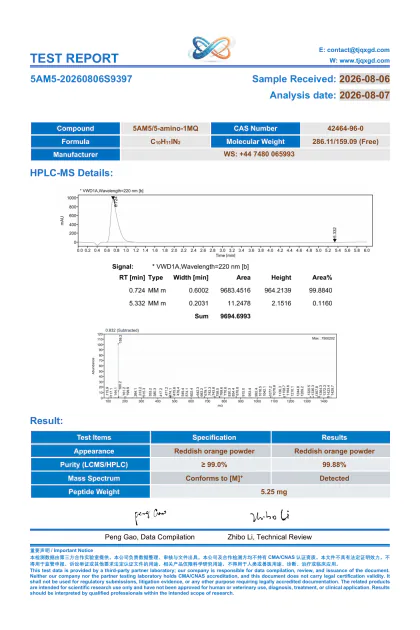
5-Amino-1MQ (5-Amino-1-methylquinolinium iodide) is a small-molecule selective inhibitor of NNMT (nicotinamide N-methyltransferase), the enzyme that catalyzes the methylation of nicotinamide using SAM as methyl donor. By inhibiting NNMT, 5-Amino-1MQ shifts the nicotinamide pool away from the methylated waste-product pathway and toward NAD+ salvage, effectively boosting cellular NAD+ in tissues with high NNMT expression. The molecule has been characterized in adipocyte metabolism, energy-expenditure, and obesity-model research, the working hypothesis being that NNMT inhibition addresses one of the metabolic-pathway aspects of age-related and obesity-related NAD+ decline. Lyochem supplies 5-Amino-1MQ as the iodide salt at ≥99.0% HPLC purity. As a small molecule rather than a peptide, the analytical workflow uses RP-HPLC plus UV-Vis identity and GC-MS or LC-MS residual-solvent profiling. Three fill sizes (5, 10, 50 mg) cover most research workflows.
Who buys this, and why
Mitochondrial-targeted peptides — MOTS-c, SS-31 (Elamipretide) — and the mitochondrial-targeting small-molecule reagents (NAD+, AICAR, 5-Amino-1MQ, SLU-PP-332) ship to research labs studying OXPHOS, ROS biology, sirtuin-mediated deacetylation, and mitochondrial dysfunction in disease models. The lipophilic / cationic character that drives mitochondrial accumulation also makes some peptides oxidation-prone in solution; working stocks should be prepared fresh or held at −80 °C when the workflow permits.
Primary buyer fit: academic and contract research laboratories.
Specifications
- CAS
- 42464-96-0
- Purity (HPLC)
- ≥ 99.0%
- Common vial sizes
- 5 mg, 10 mg, 50 mg
- MOQ
- On request
- Lead time
- 10–18 days
- Storage
- Room temperature, protect from light
Documentation available on request
- Lot-specific Certificate of Analysis (CoA)
- RP-HPLC chromatogram with peak integration
- ESI-MS identity confirmation (±0.5 Da)
- Sequence verification by LC-MS/MS
- Water content by Karl Fischer
- SDS / MSDS
- Oxidative-stability series in solution
- Bacterial endotoxin (LAL) on request
- −80 °C working-stock handling guidance
Regulatory note
Salt form (iodide vs. other) may vary across suppliers; confirm via batch COA.
Frequently asked questions
What is NNMT and why is inhibiting it interesting for metabolic research?▾
NNMT (Nicotinamide N-methyltransferase) is an enzyme that methylates nicotinamide (the B3 vitamin form) using S-adenosylmethionine (SAM) as methyl donor, producing 1-methylnicotinamide (1-MNA) and S-adenosylhomocysteine (SAH). The reaction consumes both nicotinamide and SAM, two metabolites with separate downstream roles in NAD+ salvage and methylation-cycle balance respectively. NNMT expression is elevated in white adipose tissue of obese subjects, suggesting that NNMT activity is part of the metabolic-dysfunction phenotype. Inhibiting NNMT pharmacologically (with 5-Amino-1MQ) shifts the nicotinamide pool back toward NAD+ salvage and preserves the SAM pool for methylation-cycle reactions, both effects are mechanistically reasonable hypotheses for the observed adipocyte-metabolism research readouts.
Why is the iodide salt form important to confirm?▾
5-Amino-1MQ is a quinolinium cation that requires an anion counter-ion for stable solid-state isolation. The iodide salt (5-Amino-1MQ·I⁻) is the most commonly published research-grade form and is what most cited mechanistic studies have used. Alternative counter-ions (bromide, mesylate, sulfate) exist in chemistry catalogs and produce the same cation in solution, but the solid-state behavior, hygroscopicity, and storage stability differ, and some published data is tied specifically to the iodide form. Buyers replicating published protocols should confirm the iodide form on the COA; for novel research, alternative counter-ions are generally acceptable but should be noted in the methods section.
What's the recommended in vitro working concentration range for 5-Amino-1MQ in NNMT-inhibition assays?▾
Published mechanistic studies of 5-Amino-1MQ typically use cellular working concentrations in the 1-100 μM range for NNMT inhibition readouts in adipocyte and hepatocyte cell-culture systems. Below 1 μM, the inhibition is sub-saturating and the readouts are noisy; above 100 μM, off-target effects on related methyltransferases begin to confound interpretation. For dose-response curves the typical experimental design uses a 7-point dilution from 0.3 μM to 300 μM with half-log spacing. The molecule's stability in DMSO stock solution is high (months at -20 °C); diluted working solutions in aqueous media should be prepared fresh for each experiment because the quinolinium cation can hydrolyze slowly at neutral pH.
How does 5-Amino-1MQ fit into the broader NAD+ longevity-research toolkit?▾
5-Amino-1MQ is mechanistically complementary to direct NAD+ supplementation and to NAD+ precursor supplementation (NMN, NR). Where NAD+ and its precursors add to the nicotinamide pool from the supply side, 5-Amino-1MQ reduces the loss of nicotinamide to NNMT-mediated methylation from the demand side. The combined research strategy of supplementing precursors while inhibiting NNMT is conceptually well-defined, though comparative head-to-head data is still emerging. Buyers building longevity-research protocols often source 5-Amino-1MQ alongside NAD+ and the precursor compounds; Lyochem's catalog covers NAD+, 5-Amino-1MQ, and (on request through OEM) NMN and NR.
Related peptides