Thymalin / Thymulin
Thymic immune-modulation peptide(s)
Overview
Thymalin and Thymulin are two related but distinct thymus-derived immune-modulation products that buyers frequently confuse, in part because they share a common etymology (both named after the thymic origin) and similar marketed indications. Thymulin (also called Serum Thymic Factor or FTS) is a defined 9-amino-acid zinc-binding peptide with CAS 63958-90-7, a single chemical molecule. Thymalin, in contrast, is a complex peptide-extract preparation obtained from bovine thymus tissue, marketed under the Khavinson research program with regulated status in Russia and several Eastern European markets; it is a compositional fingerprint rather than a single peptide. The two are not chemically equivalent and are not interchangeable in research or clinical protocols. Lyochem supplies both Thymalin (the bovine-thymus peptide extract) and Thymulin (the defined zinc-binding nonapeptide) under this SKU listing; buyers must specify which they want at order placement. The released batch COA explicitly identifies whether the material is the single Thymulin peptide or the multi-component Thymalin extract, buyers should always read the COA before use rather than assume catalog-listing wording.
Who buys this, and why
Buyers in this category are research labs studying immune-modulation, cytokine signalling, and antimicrobial activity. The defining QC requirement is bacterial-endotoxin control: many downstream assays (NF-κB reporters, macrophage-activation panels, neutrophil-priming readouts) are themselves activated by endotoxin contamination, so a clean LAL on the specific lot is a precondition rather than a nice-to-have. LL-37 and related cationic antimicrobial peptides additionally benefit from low-bind plasticware during dilution.
Primary buyer fit: academic and contract research laboratories.
Specifications
- CAS
- 63958-90-7 (Thymulin) / Thymalin extract, confirm via COA
- Purity (HPLC)
- ≥ 99.0%
- Common vial sizes
- 10 mg
- MOQ
- On request
- Lead time
- 14–21 days
- Storage
- -20°C, protect from light
Documentation available on request
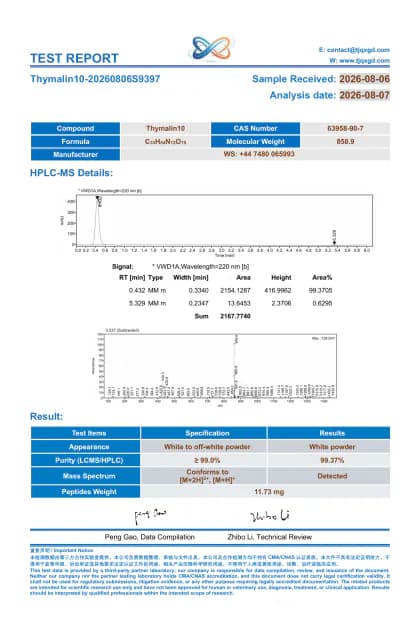
- Lot-specific Certificate of Analysis (CoA)
- RP-HPLC chromatogram with peak integration
- ESI-MS identity confirmation (±0.5 Da)
- Sequence verification by LC-MS/MS
- Water content by Karl Fischer
- SDS / MSDS
- Bacterial endotoxin (LAL, USP <85>) — recommended for in vivo work
- Microbial limits (USP <61>/<62>) on request
- Low-bind plasticware notes for cationic AMPs
Regulatory note
Thymalin (multi-peptide extract) and Thymulin (defined nonapeptide) are distinct products with different compositional standards and are not chemically interchangeable. Specify which is required at order placement and confirm exact identity via batch COA before use.
Frequently asked questions
Why is the Thymalin / Thymulin distinction so important at order placement?▾
The two products serve different research workflows despite the similar-sounding marketed indications. Thymulin (also known as Serum Thymic Factor or FTS) is a defined 9-amino-acid zinc-binding nonapeptide with CAS 63958-90-7, a single chemical molecule with reproducible structure-activity relationships. Thymalin is a bovine-thymus peptide-extract preparation containing a mixture of short peptides, with compositional fingerprint rather than single-molecule identity. The COA documentation differs accordingly: Thymulin's COA covers the single-peptide HPLC, mass spec, and water content; Thymalin's COA covers the composition fingerprint against a reference profile plus microbial / endotoxin specifications. Using one in place of the other in research protocols will produce confounded or non-reproducible results because they are mechanistically distinct preparations.
What's the typical clinical-research context for thymic-immune-modulation peptides?▾
Thymic-peptide products (Thymalin, Thymulin, plus the better-characterized Thymosin Alpha-1) occupy the immune-restoration research niche, with primary use cases in age-related immunosenescence research and adjunctive workflows for chronic viral infection or chemotherapy-related immune suppression. Russian and Eastern European clinical research traditions have used Thymalin and Thymulin for these indications since the 1980s; Thymosin Alpha-1 has been more rigorously studied in Western peer-reviewed clinical trials with approved-drug status in 35+ jurisdictions. For research workflows requiring rigorous mechanism-of-action data and Western regulatory pedigree, Thymosin Alpha-1 is the appropriate choice; for buyers specifically studying the Russian-school thymic-peptide framework, Thymalin or Thymulin (specify which) are appropriate.
Does Lyochem supply both Thymalin and Thymulin under this SKU listing?▾
Yes, both forms are available under this SKU listing, but the buyer must specify which is required at order placement. The two are sourced through different upstream supply chains: Thymulin (the defined synthetic nonapeptide) is produced by routine SPPS and supplied with standard single-peptide release documentation; Thymalin (the bovine-thymus extract) requires bovine-source supply with appropriate veterinary and BSE-related compliance documentation in addition to the standard release packet. The lead time for Thymalin is typically longer than for Thymulin because of the bovine-source supply chain. The released-batch COA explicitly identifies which form the material represents to avoid confusion at receipt.
Related peptides