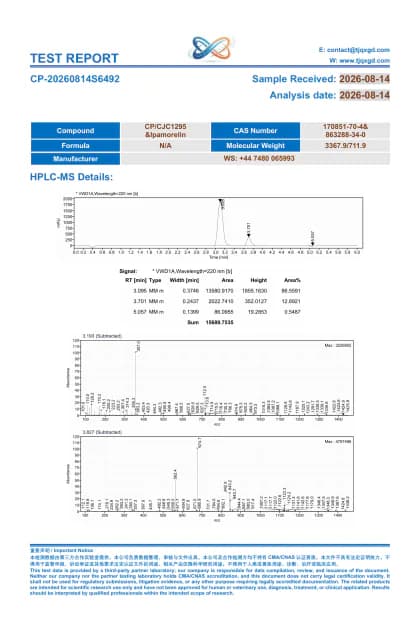
We report net peptide content, not just purity — so the milligrams you dose aren't padded with water and counter-ion. RP-HPLC purity and ESI-MS identity, on a lot-numbered COA.
Net peptide content, not just purity — RP-HPLC + ESI-MS, lot-numbered COA.
Net peptide content on every lot's COA.
Reading a Peptide HPLC Trace — A 5-Minute Field Guide for Bench Scientists. Read our briefing →
Reading a peptide HPLC trace — a field guide. Read →
On reading HPLC traces. Read →

GH-axis blend (CJC-1295 no DAC + Ipamorelin)
Lyochem buyer fit
This Lyochem page is intentionally written for research labs, core facilities, and method-development teams qualifying CJC-1295 + Ipamorelin as a reference-grade lot. It is not the pharmacy procurement owner for this SKU; the page should win differentiated searches around sequence verification, assay suitability, lot continuity, and data-packet depth.
Overview
This blend combines two GH-axis peptides that engage separate receptors and converge on somatotroph GH output: CJC-1295 (no-DAC, the Modified GRF 1-29 form) supplies the GHRH-receptor signal that mirrors hypothalamic GHRH, while Ipamorelin supplies the selective GHSR (ghrelin-receptor) signal that mirrors the ghrelin arm. Because the two inputs add together, the pairing yields GH release well above what either peptide reaches alone at matched single doses — the synergy being the whole point of formulating them together, which is why it ranks among the most-cited dual-pathway preparations in research use. Lyochem supplies the CJC-1295 + Ipamorelin blend as a co-lyophilized reference vial certified to ≥99.0% HPLC per component. The default fill is a 1:1 mass ratio (5+5 mg in a 10 mg vial), with 2+5, 5+10, 10+10 and larger totals available through Lyochem's custom-synthesis programme. We co-lyophilize rather than mix in solution because both peptides are short-lived and the freeze-dried state fixes the ratio at the lyophilization step; each release packet reports the two component purities separately plus the measured ratio in the vial actually shipped.
Applications & buyer fit
GH-axis peptides ship to research labs studying somatotropic-pathway pharmacology, IGF-axis signalling, and pulse vs. sustained-elevation GH biology. Buyers qualifying a new source typically request sequence verification on the first lot, the counter-ion form (acetate by default), and stability data at −20 °C. Blends — the CJC-1295 + Ipamorelin co-formulated lot is the canonical example — are co-lyophilised rather than solution-mixed so the ratio is locked at the lyophilisation step.
Biotech R&D Groups
Preclinical biotech and pharmaceutical discovery teams sourcing characterized peptides for receptor-pharmacology, screening, and method-development campaigns.
Every release ships with its own batch-specific CoA — identity, purity, and the analytical scope agreed at quote stage, tied to the exact lot you receive.
Review a representative batch CoA before you order, so you can confirm the packet matches what your method or sponsor audit needs.
Supplied strictly as a research reagent to research institutions — not a finished dosage form and not for human administration. Buyer qualification runs at the inquiry stage.
Specifications
Documentation available on request
Regulatory note
Sold for Research Use Only under the receiving laboratory's institutional and jurisdictional regulations. Not a finished dosage form, not labelled for human administration — Lyochem's GH-axis lots are scoped to research workflows only. Buyers studying somatotropic pharmacology should specify the counter-ion form (acetate by default) and any pulse-vs-sustained study design notes at quote stage.
Selected literature
Frequently asked questions
The two peptides carry different sequences and therefore different intact masses, which lets LC-MS resolve and identify each component within the single vial. RP-HPLC separates them into distinct peaks whose relative areas, once each is response-calibrated, quantify the actual mass ratio delivered, confirming whether the fill matches the intended one-to-one specification. Because the components are combined before drying rather than mixed later by the user, a certificate reporting both intact masses and the measured per-component content gives assurance that the released blend holds the stated ratio before it enters a GH-axis study.
Swapping the GHRH-receptor component changes both the expected masses and the mixing ratio, so the substitute blend cannot inherit the original's certificate. Each component's identity should be re-confirmed by its intact mass on LC-MS, and the two peaks separated and quantified by RP-HPLC to verify the declared proportion, for the Tesamorelin pairing that means checking the stated ten-plus-five arrangement rather than a one-to-one split. Documenting purity and per-component content for the specific pairing on hand ensures the blend used as a reference set is characterized in its own right, not by analogy.
Related peptides
Modified GRF 1-29 · GHRH analog
Ghrelin / GHSR pathway GH-release peptide
29-mer
GHRH 1-29 fragment