Reading a Peptide HPLC Trace — A 5-Minute Field Guide for Bench Scientists. Read our briefing →
Reading a peptide HPLC trace — a field guide. Read →
On reading HPLC traces. Read →

GIP / GLP-1 / glucagon tri-agonist · 39-mer metabolic research peptide
Overview
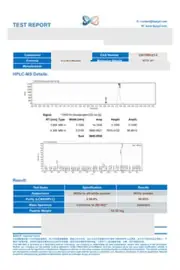
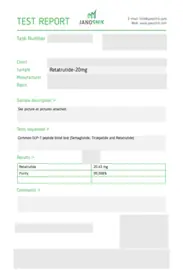
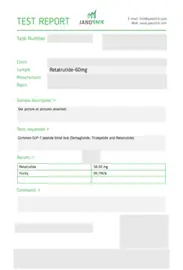
Retatrutide (development code LY3437943) is a 39-amino-acid investigational tri-agonist peptide targeting the GIP, GLP-1, and glucagon receptors. The glucagon-receptor component distinguishes it from the dual-agonist class (Tirzepatide, Survodutide) by adding a direct hepatic-energy-expenditure axis on top of the incretin-driven effects, which is the mechanistic basis for the larger body-composition signals reported in its published Phase 2 metabolic-research literature. As an investigational compound it is not an approved finished drug in any jurisdiction; the material supplied here is a research reagent only. Lyochem characterizes each Retatrutide lot as an analytical reference standard. Because aggregate production volume for this molecule is far lower than for Semaglutide or Tirzepatide, the closely-eluting deletion-sequence profile from a 39-mer SPPS run is the dominant analytical challenge, so every lot ships with RP-HPLC purity (gradient method, UV 214 nm), ESI-MS for identity, sequence confirmation by LC-MS/MS, counter-ion content, and water content by Karl Fischer. Sequence verification by tandem MS is recommended at first-time qualification. Bacterial endotoxin (LAL) and microbial limits are available on request for in vivo metabolic-model work. Fills run mg-scale for reproducible aliquoting; this is reference-grade research material, distinct from compounding-scale API supply.
Who buys this, and why
GLP-1 and metabolic-peptide buyers run incretin-pathway, body-composition, glucose-regulation, and energy-expenditure studies. Because the receptor pharmacology is sequence-sensitive, qualifying a new source means confirming identity within 0.5 Da of theoretical by ESI-MS, sequence verification by tandem MS on the first lot, and lot-to-lot consistency for reproducible metabolic research. Lyochem supplies this class reference-grade and mg-scale — distinct from compounding-grade (g/kg) API supply.
Primary buyer fit: academic laboratories at universities and government research institutes and biotech and pharmaceutical R&D groups running preclinical discovery.
Specifications
Documentation available on request
Regulatory note
Investigational compound in clinical development; not approved as a finished drug in any jurisdiction. Sold for Research Use Only under the receiving laboratory's institutional and jurisdictional regulations — not a finished dosage form and not labelled for human administration. Buyers are responsible for institutional biosafety review and verifying import eligibility in the destination market.
Frequently asked questions
Retatrutide CAS is 2381089-83-2. It is a 39-amino-acid synthetic peptide with C20 fatty-diacid lipidation. Because it is still investigational and salt/counter-ion form varies across sources, the precise molecular formula and average mass are best taken from the batch COA for the specific lot rather than a single catalog value; Lyochem confirms identity by ESI-MS against the theoretical mass for the supplied form and reproduces that value on the COA so it can be cited directly.
Tirzepatide is a dual GIP / GLP-1 agonist; Retatrutide adds glucagon-receptor agonism for tri-mechanism activity. The glucagon arm contributes a hepatic-energy-expenditure component absent from the dual-agonist class, which in the published Phase 2 metabolic-research literature corresponds to larger body-composition effects than prior incretin agents at comparable exposures. Both are 39-amino-acid peptides with C20 fatty-diacid lipidation, but the receptor-binding determinants differ, which is why they are frequent comparators in incretin-pharmacology studies.
Request the tandem-MS (LC-MS/MS) sequence-verification result on the first lot in addition to RP-HPLC purity and ESI-MS intact mass. For a low-volume 39-mer, deletion and aspartimide by-products co-elute closely on RP-HPLC and are not separable by intact mass alone; the b/y-ion ladder from LC-MS/MS is the test that demonstrates the supplied sequence matches the labelled sequence. For in vivo metabolic-model work, also request bacterial endotoxin (LAL) on the specific lot.
Related peptides