Pinealon
Khavinson neuroprotective tripeptide (Glu-Asp-Arg, EDR)
Overview
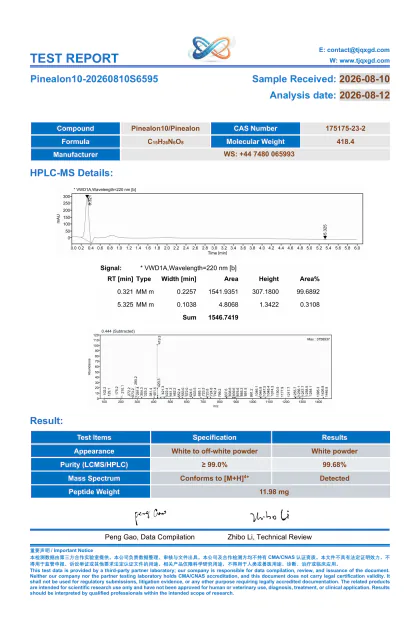
Pinealon is a synthetic tripeptide (Glu-Asp-Arg, single-letter EDR) originally identified within the Khavinson-class peptide bioregulator research program at the St. Petersburg Institute of Bioregulation and Gerontology. The peptide was first isolated from Cortexin (a complex polypeptide preparation derived from cattle cerebral cortex) and identified as one of the active short-peptide components driving Cortexin's neurotrophic effects. Pinealon is studied in research contexts for cognitive enhancement, neuroprotection in oxidative-stress models, and circadian-rhythm modulation through pineal-system signaling. Lyochem supplies Pinealon as a lyophilized powder at ≥99.0% HPLC purity. As a tripeptide, the synthesis is straightforward and the analytical packet emphasizes peak-integration HPLC plus mass spec confirming the 418.41 g/mol theoretical mass. Sequence verification is rarely the critical analytical check for a three-residue peptide. Three standard fill sizes (5, 10, 20 mg) cover most research workflows. Pinealon shares the broader Khavinson-class behavioral pattern of being studied primarily through intranasal administration in published research, though the short sequence is small enough that some workflows use oral administration with the understanding that bioavailability is variable.
Who buys this, and why
Cognitive and neuropeptide buyers are predominantly research labs running in vivo rodent studies. The dominant administration route in the published literature is intranasal — Semax, Selank, DSIP, Pinealon — because these peptides are not meaningfully blood-brain-barrier permeable when delivered systemically. For in vivo workflows, endotoxin and microbial-limit testing is recommended at the CoA stage so the bioassay readout is not confounded by contamination unrelated to the test article.
Primary buyer fit: academic and contract research laboratories.
Specifications
- CAS
- 175175-23-2
- Molecular Formula
- C15H26N6O8
- Molecular Weight
- 418.41 g/mol
- Sequence
- EDR
- Purity (HPLC)
- ≥ 99.0%
- Common vial sizes
- 5 mg, 10 mg, 20 mg
- MOQ
- On request
- Lead time
- 14–21 days
- Storage
- -20°C, protect from light
Documentation available on request
- Lot-specific Certificate of Analysis (CoA)
- RP-HPLC chromatogram with peak integration
- ESI-MS identity confirmation (±0.5 Da)
- Sequence verification by LC-MS/MS
- Water content by Karl Fischer
- SDS / MSDS
- Bacterial endotoxin (LAL) on request — in vivo workflows
- Intranasal-formulation reconstitution guidance
- Sequence ladder (full b/y-ion) on request
Regulatory note
Sold for Research Use Only under the receiving laboratory's institutional and jurisdictional regulations. Not a finished dosage form and not labelled for human administration. In vivo research workflows should request endotoxin and microbial-limit testing on the specific lot so the bioassay readout is not confounded by contamination.
Frequently asked questions
How does Pinealon fit into the Khavinson bioregulator framework?▾
Pinealon (EDR) is one of the more rigorously characterized members of the Khavinson short-peptide bioregulator class, alongside Epitalon (AEDG), Cortagen (AEDP), Bronchogen (AEDL), and Vesugen (KED). The shared hypothesis is that short tissue-specific peptide fragments isolated from animal tissues act as endogenous bioregulators of gene-expression programs in their target tissues. Pinealon was identified through fractionation of Cortexin (a cerebral-cortex peptide extract) and is the cognitive-research-focused member of the family. The other family members target other tissues, Epitalon for pineal, Cortagen for cortical signaling, Bronchogen for respiratory, Vesugen for vascular, etc.
What's the recommended research administration route for Pinealon?▾
Published Khavinson-class research with Pinealon uses both intranasal and intramuscular administration routes, with intranasal more common in CNS-focused protocols because of better brain delivery for a polar tripeptide. The molecule's small size (418 g/mol, three residues) gives it some passive permeation across the BBB that larger Khavinson tetrapeptides lack, for cognitive-research workflows specifically, this is an advantage of Pinealon over Cortagen or Bronchogen. Working dilutions should be prepared in isotonic saline (for IM) or appropriate intranasal-grade vehicle (for IN); avoid benzalkonium chloride preservatives in intranasal preparations, which can interact with short peptides.
Related peptides
Buyers who view Pinealon also ask about:
4-mer
Cortagen
≥99.0%Khavinson cortical bioregulator tetrapeptide (Ala-Glu-Asp-Pro, AEDP)
- CAS
- —
- Vial
- 20 mg
4-mer
Epitalon
≥99.0%Pineal gland tetrapeptide
- CAS
- 307297-39-8
- Vial
- 10 mg · 50 mg
7-mer
Semax
≥99.0%ACTH 4-10 analog · cognitive research peptide
- CAS
- 80714-61-0
- Vial
- 2 mg–15 mg