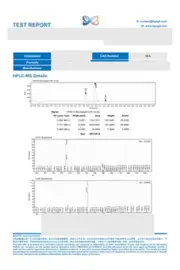
Reading a Peptide HPLC Trace — A 5-Minute Field Guide for Bench Scientists. Read our briefing →
Reading a peptide HPLC trace — a field guide. Read →
On reading HPLC traces. Read →

Co-characterized tissue-repair pairing (BPC-157 + TB-500)
Overview
The Wolverine pairing brings together two mechanistically distinct tissue-repair research peptides: BPC-157, the 15-residue proline-rich Body Protection Compound, and TB-500, the 43-residue actin-binding Thymosin β4 fragment. The two are frequently co-cited in connective-tissue and tissue-remodeling research precisely because their mechanisms are independent rather than overlapping, which is what makes the pairing a recurring subject. The material is referenced here as a characterized pairing of two standards, not for any healing or repair outcome. Following Lyochem's methodology for multi-component systems, the two peptides are characterized on their own analytical packets rather than presented as a blend whose per-component data is hidden: BPC-157 and TB-500 are each supplied as separately characterized lots — RP-HPLC purity (gradient method, UV 214 nm), ESI-MS identity, sequence confirmation by LC-MS/MS on request, counter-ion content, and water content by Karl Fischer — so each can be confirmed against its own standard before a lab prepares the combination in-protocol at its chosen ratio. The components carry individual CAS numbers rather than a single registered identifier; confirm each component's API by COA / label before use. This is reference-grade research material, distinct from compounding-scale API supply.
Applications & buyer fit
Repair peptides — BPC-157, TB-500, B7-33, PEG-MGF — ship primarily to research labs studying tissue-repair, gastrointestinal-mucosa, tendon-ligament, and vascular-endothelial models. The synthesis itself is reliable, but analytical confirmation is where suppliers differ: buyers qualifying a new source should request sequence verification by tandem MS on the first lot and compare against the labelled sequence directly.
Academic Laboratories
Universities, medical schools, and government research institutes qualifying a reference standard for a method-development or in vivo workflow.
Biotech R&D Groups
Preclinical biotech and pharmaceutical discovery teams sourcing characterized peptides for receptor-pharmacology, screening, and method-development campaigns.
Every release ships with its own batch-specific CoA — identity, purity, and the analytical scope agreed at quote stage, tied to the exact lot you receive.
Review a representative batch CoA before you order, so you can confirm the packet matches what your method or sponsor audit needs.
Supplied strictly as a research reagent to research institutions — not a finished dosage form and not for human administration. Buyer qualification runs at the inquiry stage.
Specifications
Documentation available on request
Regulatory note
Components carry individual CAS numbers — confirm each component's API identity by batch COA / label before use. Lyochem supplies this pairing strictly for Research Use Only; buyers are responsible for verifying ingredient eligibility in their destination market.
Frequently asked questions
The two act through independent molecular mechanisms — BPC-157 is a proline-rich, protease-resistant gastric-protective peptide, while TB-500 is an actin-binding 43-mer affecting cellular migration — so they are co-cited in tissue-repair research as complementary rather than redundant reagents. Lyochem supplies each as an independently characterized lot so a lab can confirm both against their own standards before combining them in-protocol.
No. BPC-157 and TB-500 are supplied as separate characterized lots, each with its own analytical packet, rather than a pre-mixed blend. Independent per-component characterization is the methodologically cleaner approach for research, because a pre-mixed vial obscures the per-component identity and purity data a citable methods section needs; the lab prepares the combination at its chosen ratio.
It is a combination of two distinct molecules, each with its own CAS Registry Number (BPC-157 and TB-500), rather than one chemical entity. Identity is established at the component level on each lot COA — RP-HPLC purity, ESI-MS identity, and LC-MS/MS sequence verification on request — and buyers should confirm each component's API by COA or label rather than relying on the pairing name.
Related peptides