SS-31 (Elamipretide)
Mitochondrial-targeted peptide
Overview
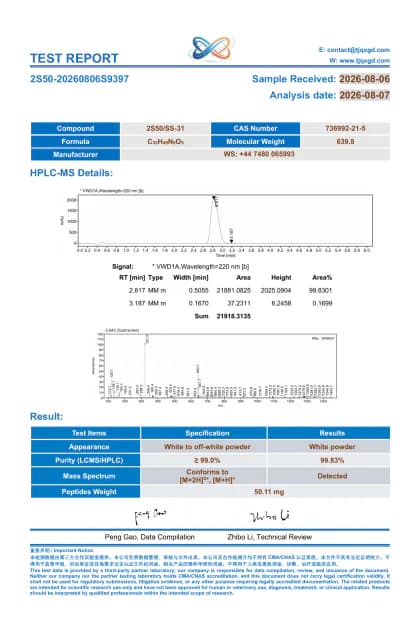
SS-31 (also known as Elamipretide, Bendavia, MTP-131) is a synthetic cationic-aromatic tetrapeptide (D-Arg-Dmt-Lys-Phe-NH₂, where Dmt is 2',6'-dimethyl-L-tyrosine) engineered as a Szeto-Schiller (SS) peptide, a class of cell-permeable mitochondria-targeted peptides developed by Hazel Szeto. The cationic-aromatic pattern allows passive accumulation in the inner mitochondrial membrane driven by the negative membrane potential, where SS-31 binds cardiolipin and protects the lipid from peroxidative damage. The protection of cardiolipin in turn preserves the structural integrity of the cristae and the function of the OXPHOS supercomplexes, the mechanistic basis for SS-31's clinical-development program in mitochondrial dysfunction disorders (Barth syndrome, primary mitochondrial myopathies) and acute-injury contexts (ischemia-reperfusion injury, contrast-induced nephropathy). Lyochem supplies SS-31 acetate as a lyophilized powder at ≥99.0% HPLC purity. The Dmt (2',6'-dimethyltyrosine) residue is non-natural and requires specialized Fmoc-protected building blocks, the analytical packet includes mass spec confirming the modified mass and is the diagnostic identity check at +28 Da relative to the natural-Tyr analog. Sequence verification by LC-MS/MS is recommended at first-time supplier qualification because Dmt-substituted peptides can have similar retention to unmodified analogs that are biologically inactive. Three fill sizes (5, 10, 50 mg) cover most research and compounding workflows.
Who buys this, and why
Mitochondrial-targeted peptides — MOTS-c, SS-31 (Elamipretide) — and the mitochondrial-targeting small-molecule reagents (NAD+, AICAR, 5-Amino-1MQ, SLU-PP-332) ship to research labs studying OXPHOS, ROS biology, sirtuin-mediated deacetylation, and mitochondrial dysfunction in disease models. The lipophilic / cationic character that drives mitochondrial accumulation also makes some peptides oxidation-prone in solution; working stocks should be prepared fresh or held at −80 °C when the workflow permits.
Primary buyer fit: academic and contract research laboratories and research laboratories that have validated this peptide into their workflow.
Specifications
- CAS
- 736992-21-5
- Purity (HPLC)
- ≥ 99.0%
- Common vial sizes
- 5 mg, 10 mg, 50 mg
- MOQ
- On request
- Lead time
- 14–21 days
- Storage
- -20°C, protect from light
Documentation available on request
- Lot-specific Certificate of Analysis (CoA)
- RP-HPLC chromatogram with peak integration
- ESI-MS identity confirmation (±0.5 Da)
- Sequence verification by LC-MS/MS
- Water content by Karl Fischer
- SDS / MSDS
- Oxidative-stability series in solution
- Bacterial endotoxin (LAL) on request
- −80 °C working-stock handling guidance
Regulatory note
Sold for Research Use Only under the receiving laboratory's institutional and jurisdictional regulations. Not a finished dosage form and not labelled for human administration. Working stocks of cationic mitochondrial peptides (SS-31 in particular) should be prepared fresh or held at −80 °C when the workflow permits.
Frequently asked questions
Why does SS-31 require the non-natural Dmt residue?▾
The Dmt (2',6'-dimethyl-L-tyrosine) at position 2 is critical to SS-31's biological activity for two reasons. First, the additional methyl groups increase the aromatic π-electron density and the hydrophobic surface area, both of which contribute to the cationic-aromatic motif that drives mitochondrial accumulation and cardiolipin binding. Second, Dmt is resistant to the aminopeptidase cleavage that would degrade the natural-Tyr analog, giving SS-31 a longer functional half-life in plasma and intracellular compartments. The natural-Tyr analog is a useful negative control in research but is not biologically equivalent.
How does SS-31 accumulate selectively in mitochondria?▾
SS-31's selectivity for mitochondrial accumulation comes from the combination of its overall +3 net cationic charge at physiological pH plus the aromatic / hydrophobic groups (Dmt and Phe). The inner mitochondrial membrane has a strongly negative trans-membrane potential (-180 mV in healthy cells), which drives the accumulation of cationic-aromatic molecules by 100- to 1000-fold over cytoplasmic concentration. SS-31 differs from earlier mitochondria-targeted compounds (like the TPP-conjugates) in that the targeting is built into the peptide backbone itself rather than added as a separate triphenylphosphonium cation, which gives more predictable pharmacokinetics and lower off-target effects on other membrane potentials.
Related peptides